Building With Purpose Online Conference

By avoiding difficult conversations, we hurt both the relationship and the potential for long-term leadership. That’s how I felt after my interview with Leah Zimmerman for the Building With Purpose Conference.

Worse than that, there were several “Difficult Conversations” that came to mind. Times I failed, disappointed, and let others down. I’ve learned from them, but it’s been a long and painful road. I want to commit to having those difficult conversations when they need to happen.


Building With Purpose

This excerpt is a part of the FREE online conference I’m hosting called Building With Purpose. This course will help you pivot during this time of social distancing and working from home.

For many of us, it’s a new experience. These experts will help you gain clarity and momentum and experience success.

To sign up for the conference, go here.

Registration is completely free and is currently open.

Building With Purpose Online ConferenceIn this conference, we hear from leading experts in:

  • Coaching
  • Business Consulting
  • Human Resources
  • Finance
  • Digital Marketing
  • And more

If you’re interested in starting or growing a business or even just wondering how to maximize your time and what to do next, enroll in the free conference.

To follow up, I’m offering all attendees a complimentary session.

To redeem your session, go here.

Difficult Conversations

Leaders model the expected standard (good or bad). Parents do this, and our kids are aware of values based on how we interact and respond to the world around us. This happens in the workplace as well through employee relationships. Church, civic engagements, volunteer work. Each of these places bears the fruit of the relationship.

Unfortunately, relationships also require work. Conflict will happen. Along the way, what we model becomes vital to healthy interaction. As leaders, we need to be willing to have those difficult conversations in healthy ways. Here are three things to help you:

1.) Start From A Place Of “Best Intentions.”

This is probably the hardest for me. In conflict, it’s easy for me to make some assumptions. Mostly, I assume that I’m right. Unfortunately, this is limits the progress we can make. When I think poorly about the other person or their intentions, I am biasing the conversation and protecting myself. If I think that they automatically have it in for me, we will never be able to mend the relationship.

2.) Practice Active Listening.

This builds from the previous point. Just because I may want to think about the best intentions, doesn’t mean I actually listen to what is being shared. This challenges me to stay engaged in the process. Listen, then repeat back what is heard. Sit up straight, lean forward, and focus on the words, emphasis, and tone behind them. How are they trying to communicate what is in my best interest? Doing this gives me more information and builds rapport.

3.) Don’t Let Fear Win.

You know what almost never works out the I imagine it in my head? Life. See also: relationships, change, and 5-year plans. However, I refuse to let that dictate the direction of my life. Those conversations we have in our head also fit here. We have two options: we can let fear dictate what we do. We can shrink back, play it safe, and limit our progress. Or, we can embrace the challenge, rise to the occasion, and push through. Difficult conversations will happen. Those who get what they want (and need) out of those will be those who push through the fear and engage with the other person.

Building With Purpose Online Conference

Whatever you get out of life will be in direct proportion to your ability to push through fear.

That’s the feeling I was left with after I interviewed Kathleen Ries-Jubenville for the Building With Purpose Conference.

Building With Purpose

This excerpt is a part of the FREE online conference I’m hosting called Building With Purpose. This course will help you pivot during this time of social distancing and working from home.

For many of us, it’s a new experience. These experts will help you gain clarity and momentum and experience success.

To sign up for the conference, go here.

Registration is completely free and is currently open.

Building With Purpose Online ConferenceIn this conference, we hear from leading experts in:

  • Coaching
  • Business Consulting
  • Human Resources
  • Finance
  • Digital Marketing
  • And more

If you’re interested in starting or growing a business or even just wondering how to maximize your time and what to do next, enroll in the free conference.

To follow up, I’m offering all attendees a complimentary session.

To redeem your session, go here.

Push Through Fear

The ability to push through fear is a difficult character trait to master. In many ways, we’ve been taught to play it safe and minimize risk. We’re told to blend in with the crowd, be normal, and aim for average. The only problem is that you were made for so much more than average.

High achievers and elite performers have all had to learn this skill, and it’s part of the wisdom that Kathleen brings. She gives us great insight into how we can push through fear, and I encourage you to watch her whole presentation.

Here now, are three takeaways and insights I have.

1.) Faith and fear cannot coexist

Because faith and fear cannot coexist, we must pick one. If I’m afraid, it’s a sign that I don’t have faith. Faith in God, my business plan, or my abilities. A lack of faith means limited thinking and small engagement. Choose faith and bold, courageous action.

2.) Lean into the discomfort

Small, actionable steps that applied every day lead to big results. We don’t have to build Rome in a day or eat the elephant in one bite (as the old sayings go). Instead, we choose this day to do one bold, daring thing. When you multiply that over 365 days a year, amazing progress happens.

3.) Find ways to reward yourself.

This can sound coutner-intuitive but it is absolutely vital for continued success. Rewarding ourselves for a job well done psychologically rewires our brain to seek out more pleasure: meaning we get more done. I regularly push my clients to set up meaningful and significant rewards as one key cornerstone to success.


How are you currently pushing through fear? Leave your action plan in the comments below!

Push Through Excuses and realize you can do it.


The measure of our success will always be determined by our ability to push through excuses.

A List of Popular Excuses

Tell me if you’ve heard (or used) any of these following excuses:

  • I’m Tired
  • The kids wouldn’t cooperate.
  • My boss was mean.
  • A bad economy.
  • No one listens to me.
  • My spouse doesn’t support me.
  • A team member (or business partner) didn’t work as hard as me.
  • I don’t have the time.

The list could keep going, couldn’t it? We’ve all been there. Longing for a vision of what could’ve been or should’ve been had things worked out differently.

They can work out differently. Things can always improve. We can always do better. Under no circumstances should we ever forego chasing our dreams.

Our success is limited only by our ability to overcome our circumstances.

Push Through Excuses

Early on in my coaching career, I had a not-so-good client. (That’s putting in nicely). I didn’t enjoy working with this person. They had a long list of dreams and desires and an even longer list of reasons why they couldn’t accomplish those dreams.

During one coaching call, he explained that he couldn’t send any resumes out because his ex-girlfriend wouldn’t have liked his resume format. Push Through Excuses and realize you can do it.

He didn’t apply for a job, because a former girlfriend wouldn’t have liked the formatting. Everyone else was getting to dictate the direction and circumstance except for him.

We worked on these issues for weeks. Stuck in a dead-end job, he wanted out badly (or so he said). Finally, after a month of inaction, I leveled with him. “Fix it this week or I’m sending your money back. I’m done working with you if you don’t want to change.”

After a few seconds of silence, he responded, “Yeah, I’m not gonna fix it this week. Thanks though.” Within thirty seconds of that sentence, we wrapped up our last call, I canceled his paperwork, and I never looked back.

I’m not sure what happened to him, but I learned a lot from him. I learned about my ideal client, staying motivated, having discipline, and the need to push through excuses.

Our ability to reach our dreams is directly related to our ability to push through excuses.

Determined At All Costs

High-achievers and success-oriented people have learned to push through excuses. Nelson Mandela remarked, “I learned that courage was not the absence of fear, but the triumph over it. The brave man is not he who does not feel afraid, but he who conquers that fear.”

Leaders are determined at all costs to push through excuses. They choose to exercise courage instead of fear. Practicing commitment to their goals is paramount. They know how much is riding on it.

Here are three tips to give us courage as we pursue our goals and push through excuses:

1.) Create Clear Goals

Clarity breeds confidence. When we know exactly what we’re aiming for, and why it matters, we can muster up the strength to continue.

2.) Recall Your Track record

If no one has told you this yet: Good job. So far, you’ve made it through 100% of everything life has thrown you. Your strength, capabilities, and commitment have gotten you this far. You have no reason to think you can’t make it through the next obstacle, however daunting it may seem.

3.) Journey Together

Life is hard. It’s even harder to do it alone. Find a friend, mentor, peer, trusted advisor, or coach. Establish a relationship with the right people who are in your corner and push you towards greatness. The right people help you tell your story better. They are absolutely critical to your journey.

We’ve all been hurt. Everyone has been lied to. We all know the pain of fear, regret, pain, and failure. Successful people have learned to tell a different story. To rewrite their old history and chart a new path.

The journey to success is not a straight line, but it is one that must be made intentionally. Lean into those goals. Pursue them with passion. Give it your all. Don’t stop. In order to reach your full potential, you must push through excuses.

Start today.


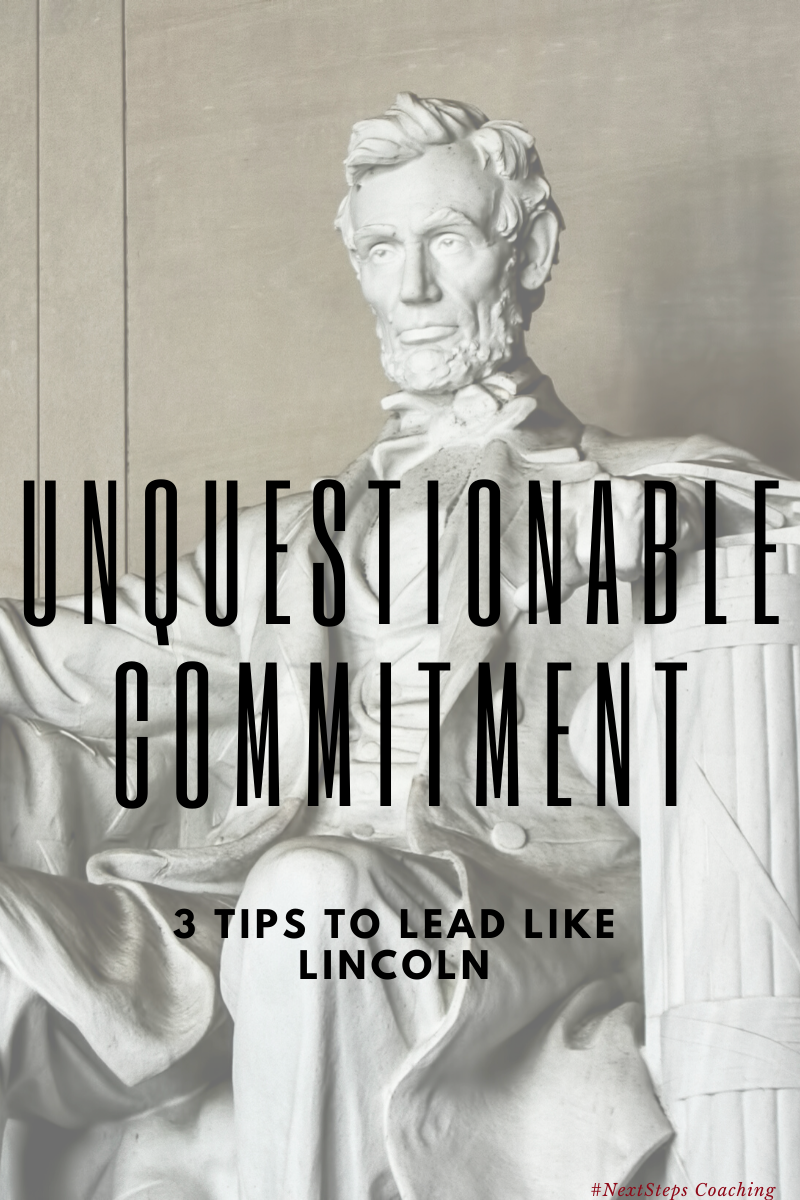
Picture of Lincoln Statue memorial with superimposed text, "Unquestionable Commitment"

Even as a young child, Abraham Lincoln was a person of unquestionable commitment.

As the story goes, he would sit in his parent’s parlor late at night listening to the conversation the adults were having. At the conclusion of the evening, he would go upstairs to his room. Instead of getting going to bed, he would instead pace his bedroom replaying the conversation. It bothered him that there were parts of the conversation he didn’t understand.

So he would replay it in his head. Over and over. Analyzing every detail until it made sense. Finally content, he could go to bed.

That was a skill that would serve him his entire life.

He became a lawyer because he understood the facts of the case better than anyone else, analyzing the details meticulously.

Widely regarded as one of the great orators of all time, he acquired that skill through his commitment to understand and effectively use words.

At the outbreak of the Civil War, he was no tactician. His peers included highly regarded West Point graduates and brilliant generals of considerable experience. Yet by the end of the Civil War, he was on par with any them when it came to military strategy. In fact, it was his policy that eventually won the war when adopted by Ulysses Grant.

In all matters of importance, Lincoln dedicated himself to study, master, and unquestionable commitment.

Our Own Leadership

Much could be said about this level of commitment to our own leadership. At least one report acknowledges that upwards of 49% of employees are disengaged, while another eighteen percent are “actively disengaged.”

Our people, those we have been called to lead, are showing up work in larger and larger numbers disengaged from the work they have been given.

The trend is troubling.

It needs to change.

Change starts with us.

What does our own leadership journey look like? Are we actively engaged in personal our own growth? Do we display the same level of unquestionable commitment that Lincoln did? Picture of Lincoln Statue memorial with superimposed text, "Unquestionable Commitment"

Lincoln spent time preparing. Whatever the circumstance or situation, he gave it his full attention. He committed himself to personal mastery and improving the outcome.

Change, personally and organizationally, starts in the mind of the leader. Our mindset, the way we approach not just our day but our every task will determine our ultimate outcome in life.

Those that watch us: family, friends, co-workers, direct reports, all will observe our actions and level of engagement and respond accordingly.

When our words and our actions don’t line up, they will always follow our actions.

Part of what we work on in the coaching relationship is showing up fully present. All areas of our lives must be accounted for. This means we pay attention to the following areas of health: spiritual, emotional, mental, physical, relational, and financial. When we show up, fully present, fully engaged, and unquestionably committed, we see great things happen.

Three Tips For Leaders

When you’re ready to bring an unquestionable commitment to all aspects of life, it can feel like a daunting task. To help you on that journey, here are things to do today that can start you on that journey.

1.) Eliminate Distraction

One of the greatest wastes of time and energy is mental distraction. Emails. Phone calls. Text message. Phone notifications. We live in a world that prides itself on distraction. Eliminate them. Close your email application. Silence your phone. Turn off notifications. Better yet, put your phone in another room for a full sixty minutes. Give the task at hand 100 percent of your focus. High-achievers always operate by this principle and it’s what allows them to get so much done in so little time.

2.) Focus On Strength.

When interacting with fellow employees or direct reports, focus on their strengths. As Don Clifton revealed in his StrengthsFinder book, the chances of being ‘actively disengaged’ in work drops to 1% when we focus on our strengths. Eliminate distraction. Then, focus on strengths. This is true for your own, and those of your employees. Improve performance and by focusing on strengths.

3.) Expect Mastery

Expecting mastery is different than expecting perfection. We don’t expect perfection. We do expect progress. From ourselves, our employees, and from those we lead. Create a plan for intentional growth. Make it clear and compelling. Then make it inspiring and motivating. Expect to master a subject. In short, you gain unquestionable commitment by practicing unquestionable commitment.


Doctor examining patients knee with superimposed text: Addressing Our Pain Points

Part of what life forces us to do is to spend time addressing our pain points. The only question is how long we’re going to wait.

Pain Is A Clue

In our bodies, pain is a clue that something is wrong. Pain in our knee points to a muscular or skeletal problem somewhere. Astute doctors will look not just at the knee, but at the ankle and hip complex as well. They will examine the surrounding joints, ligaments, and muscles. A full diagnostic could reveal that the knee hurts because of a limited range of motion in the ankle.

(This idea often called the joint-by-joint theory).

A few weeks ago, I started to get a pain in my palm. What started out feeling like a bruise soon changed to a hard area and a small bump. I took out some tweezers, pulled back the skin and found a splinter embedded deep in my hand. After a few quick cuts, the splinter was out and my hand felt instantly better. Within a few days, my hand was completely better. Doctor examining patients knee with superimposed text: Addressing Our Pain Points

Pain is a clue that something is wrong.

Understanding Pain

This analogy works in all areas of life. Pain is a clue that something is wrong and we need to spend our time addressing our pain points.

The pain of loneliness, isolation or rejection.

The pain of fear and disappointment.

We all need to address the pain of failure.

The only question is, “Is this going to hurt a lot or a little?”

Eventually, we will be forced to deal with it. Like a painful knee, we might be able to ignore other sources of pain, but it will always have to be addressed.

As the swelling in the knee worsens, so does the pain. We start to use it less. We lose mobility and stability. This makes using the knee more painful, so we try to use it less. Either through medication or a brave trip to the doctor’s office, we will eventually be forced to deal with the pain.

Our lives are all full of painful experiences. Past memories, stories, emotions, and experiences all give us our story. Some are wonderful and joyous. Our wedding, the birth of the children, that long sought after promotion.

Others are more difficult. The divorce, the funeral, the separation, and the unfavorable review.

Addressing Our Pain Points

Addressing our deficiencies is the only way forward. From both personal experience and professional practice I can tell you this with full confidence: the sooner you address a pain point, the less it is going to hurt.

I once spent a year embroiled in a workplace conflict. Well, a sort of conflict. In reality, I spent most of that year running from addressing the pain point. Eventually, it was too late and the relationship was permanently damaged.

It hurt. A lot. Sometimes, it still hurts. I regret the ways in which it soured a potential friendship and broke previous friendship. By the time I got around to addressing my own character deficiencies in the conflict, it was too late and the pain was astronomical.

The next time I was in a workplace conflict, I addressed it right away. I sensed the discord, sought out the person, remedied the problem and reconciled the relationship.

It hurt…but not that much. It doesn’t hurt anymore. Instead, that person and I are still friends. We speak occasionally, think well of each other, and have built up a relationship of mutual respect.

Both hurt. However, one was a small scratch on my journey while the other was a gaping wound.

Eventually, we will all have to deal with our pain points: through counseling, coaching, professional feedback, or numbing the pain with distracting experiences and self-medicating it away. But just like our knee pain, masking the problem with pain doesn’t make it go away. Instead, it lies to us to believe that everything is okay, all the while the damage down to our body and our leadership is deteriorating. 

Conclusion

Pain ultimately cannot be managed, it must be dealt with. It will only be masked for so long before it becomes unmanageable.

May we as leaders resist the urge to deny or numb our pain and instead address it and experience the liberating freedom that follows. Don’t be like my younger self and ignore the pain points in your life. Instead, like a wise doctor, acknowledge that pain is a sign that something is wrong and run a diagnostic test to see once wrong. Once identified, address it, grow from it, and expand your leadership capacity.